04.08.12
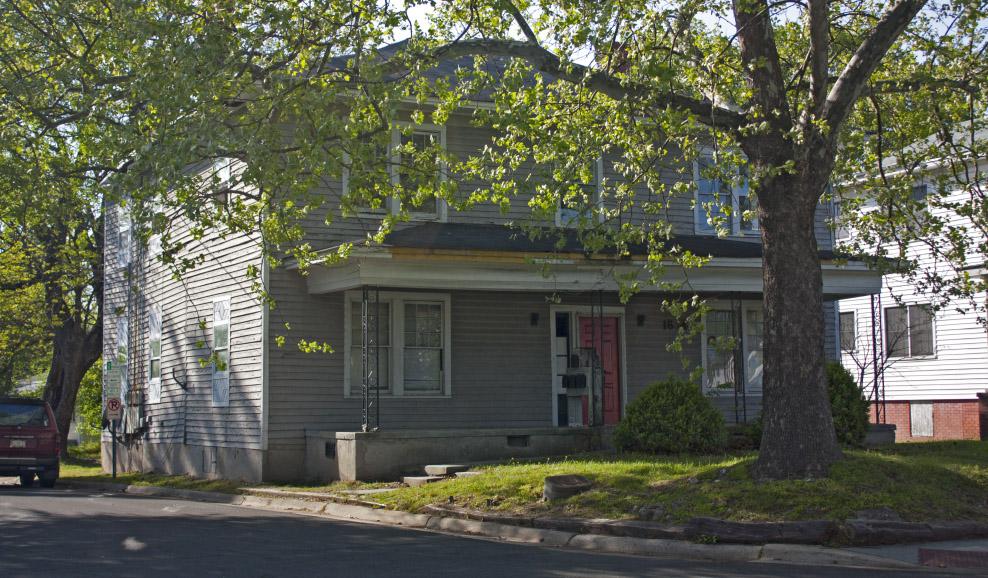
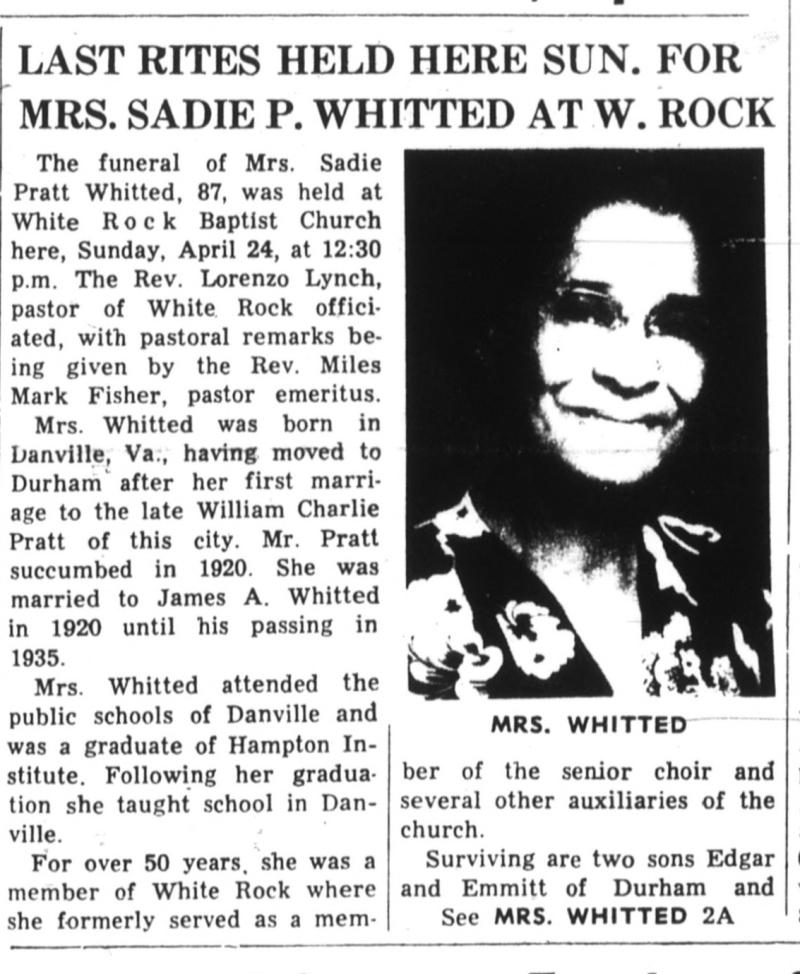
Sadie Pratt Whitted was the original owner of 1614 Fayetteville Street. Sadie first married William Pratt, who lived in Durham for most of his life, which brought her to the area. William worked as a mail carrier for ten years and was a member of the colored Masonic lodge before passing away in 1920.
Sadie remarried in 1924 to James M. Whitted, who worked as a contractor, and lived in the home until his passing in 1935.
Sadie was born in Danville, Virginia. She attended the Hampton Institute and taught while in Virginia. Sadie and William were married in Manhattan, New York, where she gave birth to their two oldest children. When she moved to Durham, she became a member of White Rock Baptist Church, and was a part of the senior choir and multiple of the church auxiliaries. Sadie was active in her community as well, participating in numerous clubs and events such as the Year-Round Garden Club, the Daughters of Dorcas, and the State Federation of Negro Women’s Clubs.
Sadie and William’s four children were: Gladys Pratt Newby, William C. Pratt Jr., Edgar W. Pratt, and Emmett C. Pratt. All four of the children lived in the home for a time.
Gladys Pratt Newby was the oldest child, born in 1903. Gladys was a teacher while living in Durham. She married Lorenzo Newby, and together they had their son Lorenzo Newby Jr., while living at 1614 Fayetteville. Gladys and her family eventually relocated to Gary, Indiana, where Sadie had moved prior to her death in 1966. Gladys finally relocated to Milwaukee, Wisconsin, before she died in 1994.
The Pratts’ second child, William Pratt Jr., passed away at the young age of 25, while living at 1614 Fayetteville. Prior to his passing, William Jr. worked as a bank teller in Durham.
The youngest two children, Edgar and Emmett, were both born in Durham, where they completed their primary education. Edgar was active in the Durham church choir scene, first at White Rock Baptist, and then eventually as the choir director at Kyles Temple A.M.E. Zion. He lived in Washington, D.C., and New York City after leaving Durham. Throughout his life, he worked as a laborer and a dry cleaner until he eventually returned to Durham and joined his younger brother’s business. Edgar’s return to Durham also marked his return to 1614 Fayetteville Street, where he lived until his death in 1975.
Emmett C. Pratt lived in Durham his whole life and had a multi-faceted career as a business owner and local political participant. He was an active member of White Rock Baptist Church throughout his life, notably as a board trustee and member of the Moore-Kennedy Bible Class. He attended Hillside High School in Durham and then West Virginia State College for his secondary education. After completing his education, he worked for the North Carolina Mutual Life Insurance Company. His business ventures included Pratt Enterprises and Pratt’s Fountain and Grill.
Emmett was very active in local politics, with membership in numerous political activist organizations, including the NAACP, the Durham County Democratic Party, and the National Black Caucus Committee for Minority Groups in North Carolina, which he chaired. He was also a voting registrar for precinct 11 in Durham. He attempted his own political career as well, running for the Durham City Council in 1978.
Emmett also worked with and for the federal government. He was one of eighteen Durham citizens trained in the North Carolina Sepia Census Crew. This group was identified as a “tan crew,” likely meaning they were an all-Black crew of census takers, meant to prevent discrimination and to elicit trust for more accurate information. Additionally, he worked in the Department of Human Resources during former North Carolina governor James Holshouser’s administration.
Emmett married Elizabeth Brooks Pratt, and together they lived at 1614 Fayetteville Street for a time. Elizabeth grew up in Washington, D.C., where she attended primary school. She attended Hartshorn Academy, Miner Teachers College, and North Carolina College (now North Carolina Central University), where she received her master's in education. She had a 42-year teaching career in the Durham public school system until she retired, during which she continued to work as a substitute teacher. Just like the other members of the Pratt family in Durham, she attended White Rock Baptist Church and was a church nursery attendant, Sunday School teacher, member of the Susie V. Norfleet Adult Bible Class, and more. She was also involved with the Alpha Kappa Alpha Sorority and Little Slam Bridge Club.
The Pratt family also rented the home out to many people, including long-term occupants Deacon Clarence Bobby Lipscomb and Sophie L. Miles, who lived in the house for 12 and 21 years, respectively.
As of 2026, the house is in good, stable condition.
Sources:
Carolina Times
Herald-Sun
Durham Sun
From the Stokesdale National Historic District
This two-story, hip-roofed house is three bays wide and triple-pile with two two-story, hip-roofed rear ells. The house has a stuccoed foundation, wood weatherboards, two interior brick chimneys, and two exterior chimneys on the rear ells. The house retains paired nine-over-one, double-hung windows on the façade. Windows on the side elevations have been replaced with shorter two-over-two, double-hung, horizontal-pane wood sash windows with wood panels above and below. Four-over-one, double-hung windows remain on the rear ells. The replacement front door retains an original five-light sidelight. The hip-roofed front porch is supported by decorative metal posts on a concrete slab floor. The earliest known occupant is James M. Whitted (building contractor) in 1925. It was also associated with the Pratt family, one of the first black land-owning families in Durham.

Add new comment
Log in or register to post comments.